Website for a small business You don’t need a big website. You need one that answers four questions.

A small business’s customer isn’t there to read. They got your name from a friend, or searched on Google, and they came to check one thing: whether to call. They want to know what you do, whether you come to them, why they should trust you and how to reach you. To see what they find, we put 41 of our checks together: 766 websites of small businesses in Israel, from 41 professions. On November 16, 2026 we went back to every home page, and also checked what customers and the law look for on almost any business website: hours, address, business number, privacy policy and reviews. Here you’ll find what kept coming up, what the law asks of almost every business, and what’s worth building. You can use this even if you don’t work with us.

Based on a check of 766 websites. Updated 16 November 2026.

Illustration: All the details are examples. Your website gets your real name, services and area.

Two customers, and one website that has to answer both.

Referral

“I got your number from a friend”

They’ve already heard of you, and want to make sure before they call. They search your name on Google and look at whether you’re still active, what exactly you do, and whether you come to them. An old website, or one with no phone number, weakens the recommendation you already got.

What they search for, for example

What they need to find on the site

  • Business name and phone, without scrolling
  • What you do, in one sentence
  • When you’re available, and in which area
  • A sign the business is active: photos, reviews, an update

Search

“I need someone, and I don’t know anyone”

They search for the service and the area, open a few results and compare quickly. They don’t know who you are, so the first screen decides it: whether you understood their problem, and whether you’re easy to reach.

What they search for, for example

What they need to find on the site

  • A page for each service you really offer
  • What’s included, and what affects the price
  • Real jobs, not stock photos
  • A call button and a WhatsApp button

We checked 766 websites of small businesses in Israel, the way a customer sees them on a phone.

On 41 of our profession pages we checked real websites, and here we put those checks into one picture. On November 16, 2026 we went back to every home page and checked what customers and the law look for on almost any business website. Most businesses already put a phone number at the top. What’s missing is everything else: most don’t say when they’re available, almost nobody gives a business number, and only about a third of the forms say anything about the details they collect. And most websites still load slowly.

  • 583 of 766

    Show a call button on the first screen

    Most businesses already do this, so the ones that don’t stand out for the wrong reason.

  • 140 of 766

    Have no phone or WhatsApp on the first screen

    A customer who came to check whether to call has to scroll or open a menu. Of everything we checked, this is the simplest fix.

  • 352 of 766

    Show a WhatsApp button on the first screen

    Fewer than half. Someone who’s at work, or can’t talk right now, will send a message if it’s easy.

  • 217 of 751

    Say when they’re available

    We counted days or hours, such as “Sun-Thu 8:00-18:00”, or a heading such as “opening hours” followed by a detail, including “24/7”. In cars, 21 of 36 say it, and in professional services, 13 of 87. Someone who got your name from a friend wants to know whether you’ll answer now.

  • 351 of 751

    Give an address with a street and number

    We didn’t count a city alone or a PO box. In law, 90 of 114 give an address, and in home repairs and emergencies, 39 of 153. That makes sense: a business that goes to its customers doesn’t have to show an address, and one that receives customers needs an exact address.

  • 129 of 751

    Show Google reviews, or link to them

    We counted a link to read or write a review, a widget that shows Google reviews, or a phrase such as “reviews on Google”. We didn’t check the reviews themselves. A customer who’s comparing may look for them anyway, and it’s better if they get there from your website.

  • 9 of 751

    Give a business or company number

    We counted “licensed dealer” (⁧עוסק מורשה⁩), its abbreviation (ע.מ.), “company number” (ח.פ.) and similar labels with a number, and also a company number written right after “Ltd.” (⁧בע"מ⁩). We widened the search to numbers without a label and read every match: the rest were phone numbers, prices and case numbers. We didn’t find such a number on any of the 114 law websites. What the law says about this is further down the page.

  • 661 of 766

    Load slowly on a phone

    The main content appeared after more than 2.5 seconds, the limit Google defines as good. This is the most common problem in the check, and it comes up in every field.

  • 261 of 766

    Take more than 10 seconds to load

    Under the test conditions, that’s about one website in three. The median website in the check showed its main content after about 7.3 seconds.

  • 350 of 751

    Link from the home page to a privacy policy

    We counted a link to a page or a window on the website itself. We didn’t count Google’s policy next to reCAPTCHA, a web company’s policy, or “private investigations” (⁧חקירות פרטיות⁩), which uses the same Hebrew word. 511 of the 751 home pages ask for details in a form, so this concerns most of them.

  • 163 of 511

    Say in the form itself what happens to the details

    Out of the home pages with a form that asks for a phone number or email. We counted a link to a policy or terms inside the form, or a sentence about how the details are kept and used. We didn’t check whether the notice is complete. 38 forms have a checkbox for receiving mailings, and in 15 of them it’s already ticked when the page opens.

  • 459 of 766

    Link from the home page to an accessibility page

    We counted a link, and didn’t check whether the website is really accessible. A link like that isn’t accessibility, but having no link is a sign that nobody stopped to check.

  • 456 of 751

    Load an accessibility toolbar or plugin

    We counted a floating accessibility button, or files from well-known accessibility plugins. 104 of them don’t link from the home page to an accessibility page. The standard tests the website itself, so a toolbar like this doesn’t replace making the website accessible, or the accessibility statement the regulations require.

  • 218 of 766

    Mark in their code what kind of business it is

    Fewer than a third. The markup doesn’t guarantee a ranking, but it tells search engines in an organized way what the business is and how to reach it.

How we checked: We combined the 41 checks we published on our profession pages, which were run on November 1 and 2, 2026, and a website that appeared in two checks was counted once. The websites were found through search, and we left out directories, rating sites and referral sites. On each website only the home page was checked, on a phone screen, and speed was measured with Lighthouse using a phone profile. On November 16, 2026 we loaded every home page again, once, on the same screen, scrolled to the bottom without clicking anything, and read the words and links on it. 751 of the 766 were read this time. The others didn’t load, weren’t read to the end, or no longer have the business’s website on them, so the new findings are out of 751, and what concerns forms is out of the pages that have a form. We counted words that appear on the page, not inside images, and read the matches. Even 766 websites aren’t a representative sample of all businesses in Israel: they show a trend in the professions we checked, not an exact market percentage. Each dot on the gauge stands for several websites. The names of the websites aren’t published.

The same check, and a big gap between fields.

Businesses that get urgent calls put a phone number at the top. In fields where the customer chooses more slowly, mainly money and beauty, that’s far less common. Speed, on the other hand, is everyone’s problem. Below the table: what the law and Google ask of almost every business with a website, as we read it in the source on November 16, 2026, and what we saw against that on the home pages. We aren’t lawyers, so where the law isn’t clear, we wrote what it says, and what’s worth asking.

The check by field: 766 websites
FieldPhone or WhatsApp on the first screenLoad slowly on a phone
Home repairs and emergencies 141 of 155 (91%) 131 of 155 (85%)
Home services 61 of 68 (90%) 57 of 68 (84%)
Renovation and construction 140 of 157 (89%) 134 of 157 (85%)
Law 98 of 117 (84%) 100 of 117 (85%)
Cars 30 of 36 (83%) 29 of 36 (81%)
Professional services 67 of 88 (76%) 77 of 88 (88%)
Money, tax and pensions 66 of 106 (62%) 97 of 106 (92%)
Beauty and grooming 23 of 39 (59%) 36 of 39 (92%)

Each website was counted in the field of the first check it appeared in. The fields are the groups of profession pages on our site, and some of them are small, so the gap shows a direction and not an exact measurement.

  • Name and ID number: already required in a price quote

    Section ⁦4ב‎⁩ of the Consumer Protection Law (⁧חוק הגנת הצרכן⁩) requires a business to disclose its name and identity number to the consumer on an order form, a warranty certificate, an installation confirmation, an offer to contract, a contract and an invoice. The home page isn’t on the list, but in our reading a price quote on WhatsApp or by email is an offer to contract. In a distance sale, online or by phone and without meeting, section ⁦14ג‎(א)‎⁩ lists the name, identity number and address first among the details that must be disclosed. For a business that isn’t a company, “identity number” is the owner’s personal ID number, under the definition in section 1 of the Companies Law (⁧חוק החברות⁩), which the law refers to. For a breach of ⁦4ב‎⁩ the commissioner (⁧הממונה⁩) may impose a financial sanction, which in 2026 is ₪8,260 for a business that isn’t a corporation. Only 9 of the 751 home pages give such a number. What applies to you, and where to write it, is worth asking a lawyer.

    Consumer Protection Law (opens in a new tab)
  • Inquiry form: the notice belongs in the form

    511 of the 751 home pages ask for a phone number or email in a form. Section 11 of the Privacy Protection Law (⁧חוק הגנת הפרטיות⁩) states that a request to a person for personal information in order to process it in a database “shall be accompanied by a notice”: whether providing it is mandatory, why the information is being collected, who controls the database and how to contact them, who it will be passed on to, and that there is a right to inspect it and ask for it to be corrected. The law excludes from the definition of a “database” a collection that holds only names, addresses and contact details of up to 100,000 people, and that doesn’t in itself reveal further information, provided its owner has no other collection with further details about the same people. In our reading, a form that also asks “what do you need”, or a business that manages its customers in a system, no longer falls under this exception. In 348 of the forms we didn’t see such a link or sentence in the form itself. In our reading, a link at the bottom of the page is a start, and the notice should be next to the fields. Mailings are a separate matter: section ⁦30א‎⁩ of the Communications Law (⁧חוק התקשורת⁩) requires “explicit prior consent” for advertising by email and SMS, with a narrow exception, on conditions, for someone who gave their details during a purchase or negotiations for a purchase. In 15 of the 38 forms with a mailing checkbox, it’s already ticked when the page opens. Whether that’s explicit consent, ask a lawyer.

    Privacy Protection Law (opens in a new tab)
  • Accessibility: a toolbar isn’t a statement

    Regulation ⁦35ה‎⁩ of the service accessibility regulations (⁧תקנות הנגישות לשירות⁩) requires anyone who has to make their website accessible to display on it, in a prominent place, an accessibility statement: which adjustments were made, the accessibility coordinator’s details if one has to be appointed, and a way to report a problem. 456 of the 751 home pages load an accessibility toolbar or plugin, and 104 of them don’t link to an accessibility page. Regulation ⁦35ו‎(ז)‎⁩ exempts a VAT-exempt dealer (⁧עוסק פטור⁩), and anyone whose average annual turnover is up to ₪100,000, from the website accessibility adjustments. And under regulation ⁦35א‎(ד)‎⁩, a deviation from the requirements isn’t considered a breach unless a notice was sent and it wasn’t fixed within a reasonable time, and no later than 60 days. According to Kol-Zchut (⁧כל זכות⁩), the responsibility lies with whoever runs the website, not with whoever built it. What the standard tests, we wrote on our website design page.

    What to know before you build a website (opens in a new tab)
  • Without https, Chrome asks before it opens

    According to Google, from Chrome version 154, in October 2026, the browser asks the user’s permission before the first visit to a public website without https. 10 of the 751 home pages still open on http, even after the website’s own redirects. In our check, Chrome 157 stopped before a website like this until we turned the setting off. The fix is a security certificate, and a permanent redirect from every http address to its https address, set up with whoever hosts the website.

    Google’s announcement (opens in a new tab)
  • Address: only if customers come to you

    Google’s guidelines for a Business Profile ask a business that goes to its customers to hide the business address, and give a plumber who works from home as an example. A business that receives customers needs an exact address, and its regular hours for customers. This matches what we saw: in law, 90 of 114 home pages give a street and number, and in home repairs and emergencies, 39 of 153. What matters is that the website and the profile say the same thing. The hiding is in the Google profile: in a distance sale, the law still asks you to disclose an address to the customer.

    Google’s guidelines (opens in a new tab)
  • Reviews: you can ask, you can’t buy

    129 of the 751 home pages show Google reviews or link to them. Google allows you to ask customers for a review with a link or a QR code, and explicitly prohibits giving a product or service for free or at a discount in exchange for a review, or in exchange for changing or removing a negative review. A link to write a review, in a message after the job, does the same thing without that risk.

    Google’s review policy (opens in a new tab)

What to build on a small business’s website.

A small business website doesn’t have to be big. Usually, five or six good pages do more than twenty thin ones. What most of the home pages we checked are missing isn’t another page, but a few lines: when you’re available, who the business is under its registered name, and what happens to the details people leave in the form. This is a good order to start from, and you can drop whatever doesn’t suit you.

  • Home page: four answers

    What you do, where you go, why to trust you and how to reach you. Call and WhatsApp in one tap, on the first screen.

  • A page for each real service

    What’s included, who it’s for, how long it takes and what affects the price. A service you don’t want more of doesn’t need a page.

  • Your work, with details

    What the problem was, what you did, and in which area. Photos you took on your phone are better than nice stock photos.

  • Who’s behind the business

    Name, years of experience, training or a license if you have one, and who actually provides the service. Also the name the business is registered under, and the business or company number, if you’re willing to publish it. A customer who got a recommendation checks exactly this.

  • Questions customers really ask

    What you answer on the phone every week. Answers like these save calls, and people search for exactly them on Google and in AI tools.

  • Contact

    Phone, WhatsApp and hours. An address and a map if customers come to you, and if not, where you go. A link to your reviews, and a short form with a sentence about the details it asks for. Exactly the same details as on your Google Business Profile.

How people find you: Google, Maps and AI.

A small business doesn’t need to compete for a general word. It needs to show up when people search for its name, its service and its area, and to look the same everywhere.

  • Google Business Profile

    It’s sometimes the first thing people see, even before the website. Fill in the name, category, services and hours, and link to the website. 248 of the 751 home pages link to Google Maps or show it, and 116 link to Waze. The phone, address and hours should be identical in both places.

    Google’s guide (opens in a new tab)
  • Markup in the code

    Only 218 of the 766 websites marked their type of business. schema.org has LocalBusiness, and more precise types for many professions. In Google’s guide to local business markup, the name and address are required fields, and the hours and phone are recommended. The markup has to match what’s on the page.

    Google’s guide (opens in a new tab)
  • Answers only you can write

    What customers ask, what surprised you this week, and what you’d do differently. Google recommends content from personal experience, not a summary of what’s already online. You tell the story, we help with the wording, and the final approval is yours.

    Google’s guide (opens in a new tab)

What’s true for all professionals, and what Google itself says about SEO and GEO: on the professionals page.

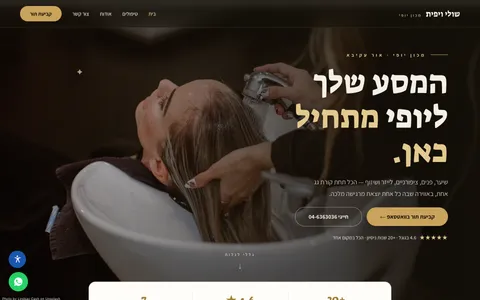
The Shuli & Yafit website

From our work: Shuli & Yafit.

Business website · Beauty salon · Or Akiva

The Shuli & Yafit website opens with booking on WhatsApp and calling, shows its treatment areas in one place, and explains in three steps how you get from a message to a treatment. That way a new customer understands what’s on offer without calling.

The project was built during the DynaTech period.

FAQ

Questions about a website for a small business

A question that isn’t here?

Write to us, and we’ll get back to you with an answer.

How much does it cost to build a website for a small business?

There’s no fixed price list. We set the proposal after a short call, based on the number of pages and who writes them. With a new website you start by seeing a first concept, and we move on to payment only when it suits you.

Have you built websites for small businesses?

Yes. Our work page has websites of small businesses, such as a beauty salon, a gas technician and a hair extensions studio. You can open them and see how they look on a phone.

What does the law require on a small business’s website?

There’s no single list for every business. What applies to almost everyone: an accessible website with an accessibility statement, unless you’re exempt, and a notice under section 11 of the Privacy Protection Law next to a form whose details are kept in a database, as the law defines one. If you close deals remotely, you also have to disclose a name, ID number and address under section ⁦14ג‎⁩ of the Consumer Protection Law, and mailings require explicit prior consent under section ⁦30א‎⁩ of the Communications Law. We aren’t lawyers, and it’s worth checking your case with a lawyer.

Do I have to put my licensed dealer number on the website?

We didn’t find a general duty to write it on the home page. Section ⁦4ב‎⁩ of the Consumer Protection Law requires a name and identity number on an offer to contract, a contract, an order form and an invoice, and section ⁦14ג‎⁩ requires disclosing them in a distance sale. For a business that isn’t a company, that’s the owner’s personal ID number, so think about where you write it. In our check, only 9 of 751 home pages gave such a number.

Does a small business website need a privacy policy?

If the details from the form are kept in a database, section 11 of the Privacy Protection Law requires the request to come with a notice: why the information is being collected, whether providing it is mandatory, who it will be passed on to and how to contact you. The law excludes from the definition, on conditions, a collection that holds only names and contact details, so if your form asks only for these, it’s worth asking a lawyer what applies to you. A policy page is a common way to explain this, and a short sentence in the form links to it. 350 of the 751 home pages we checked link to such a policy.

Is an accessibility plugin enough to comply with the law?

In our reading, no. The regulations refer to an Israeli standard that tests the website itself, and regulation ⁦35ה‎⁩ also requires an accessibility statement in a prominent place. We went through what the standard tests on our website design page. 456 of the 751 home pages load an accessibility toolbar, and 104 of them don’t link to an accessibility page.

My website is still on http. Is that a problem?

Yes, and now people can see it too. According to Google, from Chrome 154, in October 2026, the browser asks for permission before the first visit to a public website without https. Ask whoever hosts your website to install a security certificate, and to redirect every http address to its https address.

Do I need an address on the website if I don’t have a shop or an office?

Google’s guidelines ask a business that goes to its customers to hide the address in its profile, and to set a service area instead. On the website, write where you go. If customers come to you, write an exact address, hours and how to get there, exactly as in the profile.

I have a Google profile and a Facebook page. Do I need a website too?

Not always. If most of your customers come from recommendations, and you have a complete, up-to-date profile, you can start with that. A website gives you what a profile doesn’t: a proper page for each service, explanations in your own words, and a place that belongs to you and not to a platform.

Can I build it myself?

Yes, and with a website builder you can get to a reasonable website. What we checked doesn’t depend on the tool: a phone on the first screen, speed, hours, a form that says what happens to the details, and an accessibility statement. It’s worth checking this yourself before you pay anyone.

How do I check if my website is slow?

Google has a free tool, PageSpeed Insights: paste in an address and look at the LCP time on a phone. Up to 2.5 seconds is good according to Google. The result changes from test to test, so it’s worth running it more than once.

Sources

  1. Consumer Protection Law, 5741-1981: sections 2, ⁦4ב‎⁩, ⁦14ג‎⁩ and ⁦22ג‎⁩ (in Hebrew) (opens in a new tab)
  2. Companies Law, 5759-1999: section 1, the definition of “identity number” (in Hebrew) (opens in a new tab)
  3. Privacy Protection Law, 5741-1981, section 11 (in Hebrew) (opens in a new tab)
  4. Communications Law (Telecommunications and Broadcasts), section ⁦30א‎⁩ (in Hebrew) (opens in a new tab)
  5. Equal Rights for Persons with Disabilities (Accessibility Adjustments for Service) Regulations, regulations ⁦35א‎⁩, ⁦35ה‎⁩ and ⁦35ו‎⁩ (in Hebrew) (opens in a new tab)
  6. Kol-Zchut: making websites and apps accessible to people with disabilities (in Hebrew) (opens in a new tab)
  7. Google Online Security Blog: HTTPS by default, October 28, 2025 (opens in a new tab)
  8. Google Business Profile: guidelines for representing your business on Google (in Hebrew) (opens in a new tab)
  9. Google Business Profile: review policy (in Hebrew) (opens in a new tab)
  10. Google Business Profile: the business profile (in Hebrew) (opens in a new tab)
  11. Google Search Central: local business structured data (opens in a new tab)
  12. Google Search Central: spam policies (opens in a new tab)
  13. Google Search Central: optimizing for AI features in Search (opens in a new tab)
  14. web.dev: defining LCP (opens in a new tab)
  15. PageSpeed Insights (opens in a new tab)
  16. schema.org: LocalBusiness (opens in a new tab)

Written and checked by the SNM team. Updated 16 November 2026. This information is about building a website and isn’t legal advice. The binding text is that of the law and the regulations.

Contact

Want to see a concept for your business’s website?

Tell us what the business does, in which area, and where your customers come from today. If you already have a website, send a link and we’ll tell you what we’d fix first.

There is no fixed price list: the proposal depends on the scope of work and your needs, after an introductory call.

What interests you (optional)

Your details are used only to get back to you. Privacy policy