
Online store development in Israel A store where people understand the product, and order without hesitating.
An online store has no salesperson to answer questions. The photos, descriptions, prices and options have to do that job: explain, reassure and lead to an order. So building an online store starts from your products, and from the way you really handle orders.
Same as with websites: first you see a concept for the store, then you decide.
 Miel
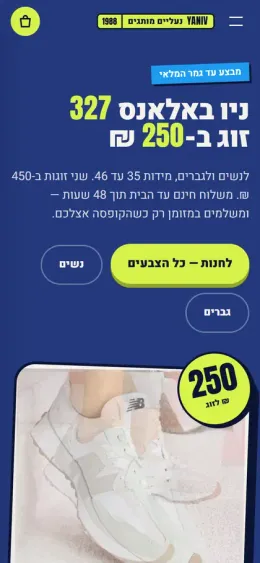 Yaniv Brand Shoes
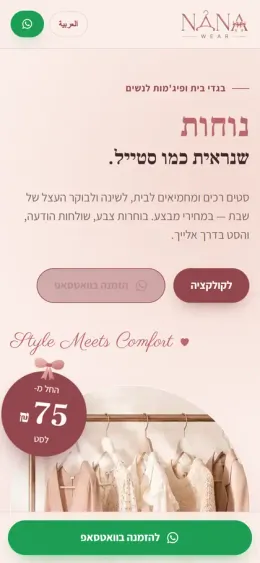 NANA WEAR
Who it’s for: an online store.
- Businesses selling today on WhatsApp, on Instagram or in a physical shop that want an organized place for orders
- Brands whose catalog has grown too big to manage by message
- Existing stores where customers get stuck before paying
- Makers and craftspeople selling custom products
Where shoppers get stuck in an online store.
-
TodayCustomers keep asking about sizes, materials and prices.
AfterProduct pages that answer up front: good photos, details, options and a clear policy.
-
TodayIt’s hard to find a product in the catalog.
AfterCategories, filters and search matched to the way your customers look for things.
-
TodayOrders come in from everywhere and disappear.
AfterAll orders in one place, with status and full details.
-
TodayBuying is clumsy, especially on a phone.
AfterA short cart and checkout, with payment methods that suit the business.
Types of online stores we can build.
-
A full store with on-site payment
Catalog, cart and payment through a payment provider, with an order confirmation to the customer and the business.
-
A catalog with WhatsApp ordering
The customer picks products, and the cart goes to the business as one tidy message to complete the order.
-
Custom products
Choosing a material, color or size, with a display that updates to match the choice.
-
A store in several languages
For example Hebrew and Arabic, with a language switch and full content in each.
From our work
-

Store · Jewelry store · Gedera
Miel
A jewelry store with a choice of metal for each item, and a cart sent as one WhatsApp message.
Screenshots from the project
-
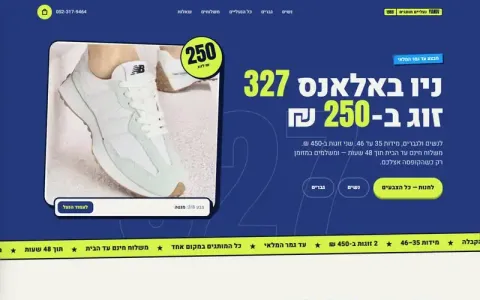
Store · Shoe store · Dimona
Yaniv Brand Shoes
A store with a catalog, category and product pages, and a cart sent as an order on WhatsApp.
Screenshots from the project
-
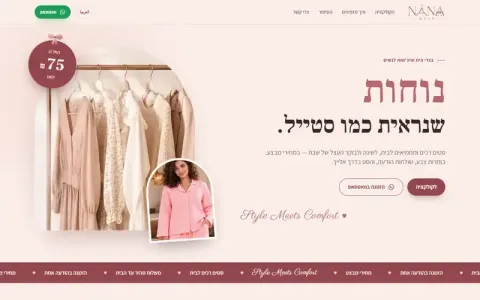
Store · Pajama and homewear boutique
NANA WEAR
A store in Hebrew and Arabic, with a language choice at the entrance and a WhatsApp order card for each set.
Screenshots from the project
The projects were built during the DynaTech period. All work
What an online store must do by law.
Selling on a website is a “distance sale” under the Consumer Protection Law (חוק הגנת הצרכן), and it has its own rules. These are the main ones, taken from the wording of the law. The store’s terms are written to follow them, and it’s better to have a lawyer go over them.
-
What to show before the customer buys
Under section 14ג(א), in distance marketing the business must disclose at least: its name, ID number and address, the main features of the product, the price and payment terms, when and how the product will be supplied, how long the offer is valid, what the warranty is, and how to cancel. In a store, this goes on the product page, in the cart and in the terms.
-
A written document with the transaction details
Under section 14ג(ב), by the time of shipping the customer has to receive a written document with the details of the business and the product, the price and payment terms, the way to cancel, the manufacturer’s name and the country of manufacture, and the warranty. In an online store, it’s convenient to send it together with the order confirmation.
-
14 days to cancel, and a capped cancellation fee
When buying a product, the customer may cancel from the day of the transaction until 14 days from the day they received the product or the document, whichever is later (section 14ג(ג)). When the cancellation isn’t due to a defect or a breach by the business, the business refunds the money within 14 days, and may charge a cancellation fee of up to 5% of the price or ₪100, whichever is lower (section 14ה(ב)).
-
Four months for some customers
A person with a disability, a senior citizen (age 65 and over) and a new immigrant may cancel a distance sale within four months, provided the transaction included a conversation between the business and the customer, including a conversation by electronic communication (section 14ג1(ג)). A store that also closes orders by phone needs to take this into account.
-
What can’t be canceled
The right to cancel doesn’t apply, among other things, to perishable goods (products that spoil, such as food), to products made specially for the customer following the order, or to products that can be recorded or copied once the customer has opened the original packaging (section 14ג(ד)). A store selling custom products needs to say this clearly, right on the product page.
How we build an online store, from product to order.
-
Mapping products and orders
How many products, which options, how payment and shipping work and who handles the order.
-
Choosing the right route
A full store with card payments or a catalog with WhatsApp ordering, depending on the scope and your needs.
-
Store concept
A sample home page, category page and product page, to view on a computer and a phone.
-
Products and settings
Products, prices, shipping, policy documents and the connection to the payment provider.
-
Test orders
We test the whole path from product to order, including the messages the customer and the business receive.
-
Launch and training
We go live and show you how to add a product and handle an order.
What’s included in building the store.
The exact scope is set in the proposal, according to the business’s needs. These are the things that usually come up in the conversation.
What can be included
- Store and product page design in your brand’s style
- Categories, filters and search as needed
- A cart, plus on-site payment or WhatsApp ordering
- Fully adapted for buying on a phone
- Shipping and pickup setup
- SEO basics for category and product pages
Important to know
- The business opens the account with the payment provider, and the processing fees are the provider’s.
- Product photography and writing descriptions for the whole catalog go into the proposal only if agreed.
- Terms and the returns policy are written from the information the business provides, and we recommend having a lawyer review them.
- Connecting to outside point-of-sale or inventory systems is possible, and is checked separately.
FAQ
Questions about Online stores
A question that isn’t here?
Write to us, and we’ll get back to you with an answer.
Which platform is right for my store?
It depends on how many products you have, how often they change and how people pay. For a small store selling mostly custom products, a catalog with WhatsApp ordering can be enough. A store with many products and on-site payment needs a full e-commerce platform. The recommendation comes after we understand the business.
Can I take payment on the site?
Yes, through a payment provider. The business opens an account with the provider, and we connect it to the store and test the payment process before launch.
Who uploads the products?
We can upload the initial catalog, or you can upload it yourselves after training. A mix also works: we build the structure and upload sample products, and you carry on.
I already have a store. Can it be improved instead of rebuilt?
Sometimes, yes. We check where customers get stuck, in search, on the product page, in the cart or at payment, and start from the point that makes the biggest difference.
Can I take orders on WhatsApp instead of card payments?
Yes. The customer picks products and sends the cart as a tidy message, and you complete the order and payment directly with them. This works especially well for custom products or small quantities.
What else connects to this.
All services- SSystems Website design for businesses A website that explains the service clearly and leads to an inquiry.
- NNetworks Automations and CRM integrations Less copy-paste, more organized follow-up on every inquiry.
- MMarketing Paid advertising and content creation Campaigns and content that bring the right people to the right page.
Contact
Got products? Let’s build them a home.
Tell us what you sell and how people order from you today, and we’ll work out the right route together.
There is no fixed price list: the proposal depends on the scope of work and your needs, after an introductory call.
Your details were received.
We’ll call you back on the number you left. Want to continue right now?
Open a prepared WhatsApp messageThe message opens on your side, and you press send.