
Website design for businesses in Israel A website that explains what you do, and leads to inquiries.
Designing a business website starts with one question: does a visitor see within a few seconds that they’ve come to the right place? A good business website answers them right away: what you do, who it’s for, why choose you and how to get in touch. A landing page does the same around one offer, for a campaign or a specific service.
See a first concept for your website. Then decide.

Who it’s for: business website design.
- Businesses with no website, or with one that no longer represents them
- Service providers whose customers check them out online before calling
- Businesses running a campaign that need a focused page for it to lead to
- Business owners who want to see how the website will look before they commit
Why business websites don’t bring in inquiries.
-
TodayCustomers don’t understand exactly what you offer.
AfterA structure that starts from the customer’s questions: what, for whom, how it works and how to get started.
-
TodayThe website looks good on a computer and clumsy on a phone.
AfterPlanned for the phone first: readable text, comfortable buttons and a short path to an inquiry.
-
TodayPeople visit the website, but few get in touch.
AfterClear calls to action, a short form, and phone and WhatsApp links right where people make up their minds.
-
TodayEvery change to the website is a project.
AfterAn organized structure that lets you add a service, a portfolio item or a page without rebuilding.
A business website, a landing page or a refresh of an existing one.
-
A business website for a service provider
A home page, a page for each service, past work, FAQs and contact, with every page leading to the next step.
-
A campaign landing page
One offer, a short explanation, proof and a short form, with no menu to distract people.
-
A website for several service areas
A page for each area or branch, with the information that matters to people searching there.
-
Refreshing an existing website
We keep what works, improve what doesn’t and set up redirects from the old addresses.
A professional? There’s a separate page for each profession, with what matters to your customers.
From our work
-
Business website · Certified gas technician · Netanya
GasPro
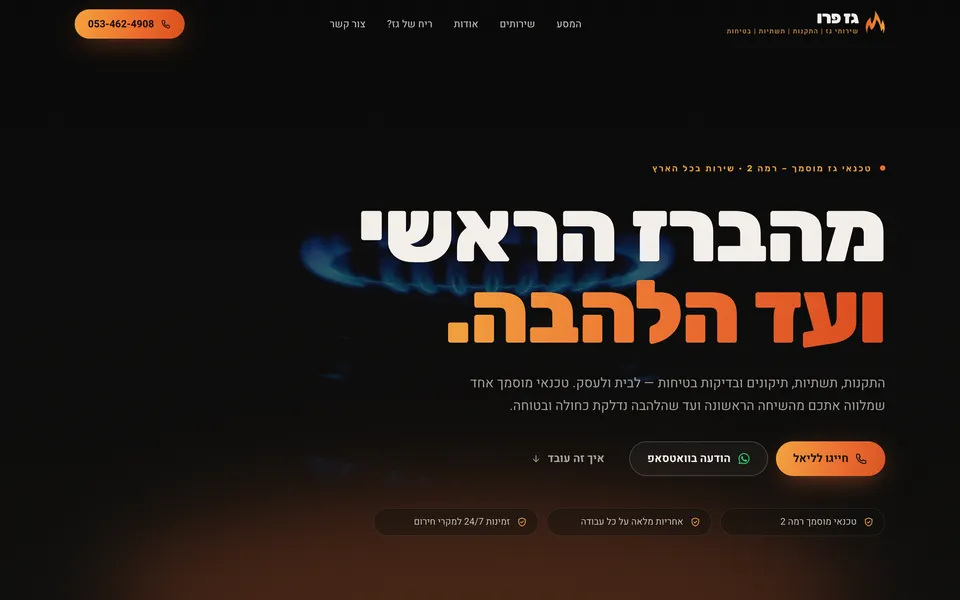
A website for a gas technician, built as a single gas line from the main valve to the flame, with quick contact by WhatsApp and phone.
Live site (opens in a new tab) -
Business website · Beautician and naturopath · Kfar Yona
Shlomit Raich
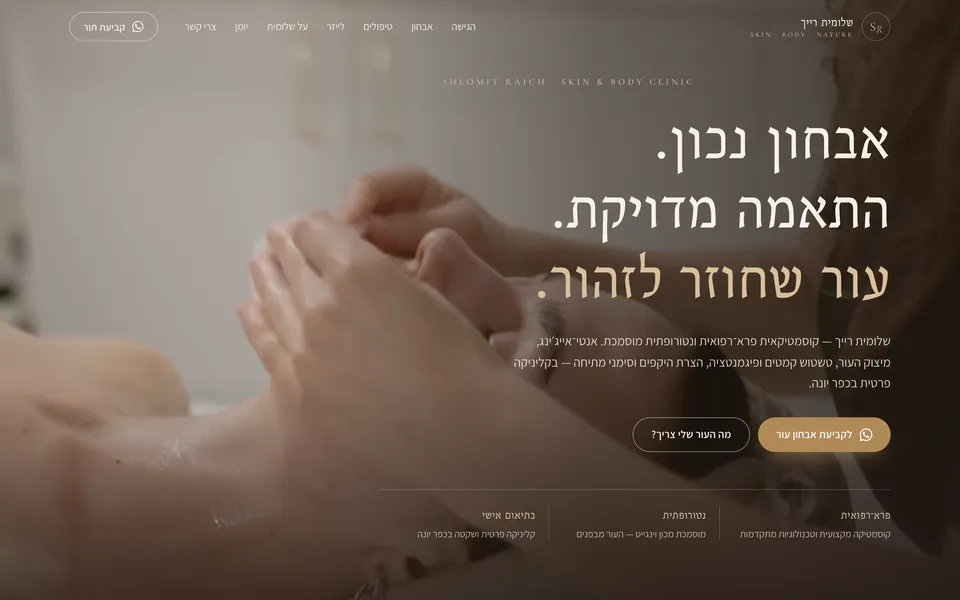
A clinic website with a map of the skin’s layers along the scroll, and a picker that helps you reach the right treatment and get in touch on WhatsApp.
Live site (opens in a new tab) -
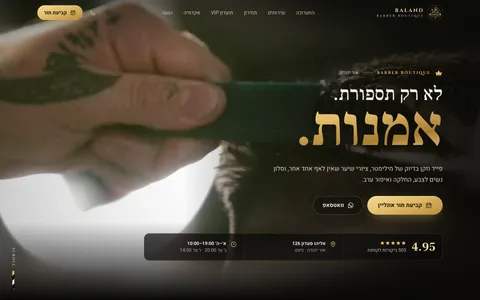
Business website · Barbershop and salon · Or Yehuda
BALAND
A website with the look of a night gallery: real haircuts, a tabbed price list, and opening hours in a prominent place.
Live site (opens in a new tab)
The projects were built during the DynaTech period. All work
What to know before you build a website.
Five things that come up in almost every website project, and that are worth settling before you choose who will build it.
-
Accessibility is required by law
Under regulation 35א of the service accessibility regulations (תקנות הנגישות לשירות), a website that serves the public has to meet Israeli Standard 5568 at level AA, and under regulation 35ה it has to display an accessibility statement. The regulations exempt a VAT-exempt dealer (עוסק פטור) and a business whose average annual turnover doesn’t exceed ₪100,000 (regulation 35ו(ז)). The standard tests the website itself: contrast, keyboard navigation, alternative text for images, and forms that screen readers understand. That’s why accessibility is built into the website from the start, and a plugin added on at the end doesn’t replace it.
-
The domain and accounts in the business’s name
The domain, the hosting, Google Search Console and the analytics tools should be registered to the business, and whoever builds the website gets access to them. That way you can switch providers without losing the address, the data or what’s been built up on Google.
-
Speed is measured, not felt
Google measures the browsing experience with three metrics called Core Web Vitals: how long the largest part of the screen takes to load (LCP, good up to 2.5 seconds), how quickly the page responds to a click (INP, good up to 200 milliseconds), and how much the page shifts while it loads (CLS, good up to 0.1). Check them on a phone too, not only on a computer.
-
A new website without losing Google
When you replace a website, the addresses change. Every old address that people reached from Google or from links needs a permanent redirect (301) to the new address that matches it. Otherwise, anyone who lands on it sees an error page. After launch, check in Search Console that the new pages are being crawled.
-
The price depends on the scope
What mostly affects the price of building a website is how many different types of pages need to be designed, who writes the content, which connections are needed (a form into an inquiry system, appointment booking, payment), how many languages, and how much support is needed after launch. The number of pages alone says less: ten service pages on the same template are a different job from ten pages that are each built differently.
Sources
- Equal Rights for Persons with Disabilities (Accessibility Adjustments for Service) Regulations, 5773-2013, regulations 35 to 35ו (in Hebrew) (opens in a new tab)
- web.dev: Web Vitals, the thresholds for LCP, INP and CLS (opens in a new tab)
- Google Search Central: moving a site with URL changes (opens in a new tab)
How we build a business website, from the first call to launch.
-
Introduction and planning
What the business offers, who the customers are, what they ask before getting in touch and which pages are needed.
-
First concept
Structure, messaging and design for the main pages, at a link you can open on a computer and a phone.
-
Feedback and adjustments
We go over the concept together and refine it, within the scope set in the proposal.
-
Approval and payment
When the concept suits you, you approve the proposal and move on to payment.
-
Completing the build
All the pages, forms and connections, testing on different screen sizes and the SEO basics.
-
Launch
Connecting the domain, a final check on the live site and an explanation of how to make updates.
What’s included in the website design.
The exact scope is set in the proposal, according to the business’s needs. These are the things that usually come up in the conversation.
What can be included
- A design built around the business and its own style
- Adapted for phone, tablet and computer
- An inquiry form, phone and WhatsApp
- SEO basics: titles, descriptions, clean URLs and a sitemap
- Right-to-left Hebrew, with English and numbers mixed in correctly
- Help with wording the content, as agreed
Important to know
- Full content writing and professional photography aren’t automatically included. They go into the proposal only if agreed.
- Outside services, such as a domain, hosting and paid tools, are checked in advance and paid to the providers.
- The number of adjustment rounds is set in the proposal.
- Organic SEO and paid advertising are separate services.
FAQ
Questions about Website design
A question that isn’t here?
Write to us, and we’ll get back to you with an answer.
What’s the difference between a business website and a landing page?
A business website presents the whole business: services, past work, an about page and contact. It also serves people searching on Google. A landing page is one page built around one offer, usually for a campaign, and it has one goal: an inquiry. Many businesses need both.
What do I need to prepare before we start?
It’s enough to come to the call knowing what you offer and to whom. A logo, photos and existing text help, but we can also start without them and build the content together.
Can I update the website myself?
If that matters to you, it goes into the planning from the start: we choose a structure that lets you update what changes in your business, and we show you how at handover.
How long does it take to build a website?
It depends on the scope: a landing page takes less time than a website with many pages, and how soon the content is ready makes a big difference. We agree on the schedule in the proposal, after the introductory call.
And what if the first concept doesn’t suit me?
That’s what it’s for: seeing before deciding. We go over your comments and refine it, and payment comes only after you approve the concept.
How much does a business website cost?
There is no fixed price list. The price depends on the scope of work: how many pages, which connections, who prepares the content and how much ongoing support is needed. After an introductory call you get a clear proposal.
What else connects to this.
All services- SSystems Online store development A store where the products are easy to understand and to order.
- MMarketing SEO and GEO services Content and structure that help customers and search engines understand the business.
- MMarketing Paid advertising and content creation Campaigns and content that bring the right people to the right page.
Contact
Want to see a concept for your website?
Tell us about your business. We’ll set up a short call, and after it you’ll know exactly what the next step is.
There is no fixed price list: the proposal depends on the scope of work and your needs, after an introductory call.
Your details were received.
We’ll call you back on the number you left. Want to continue right now?
Open a prepared WhatsApp messageThe message opens on your side, and you press send.